

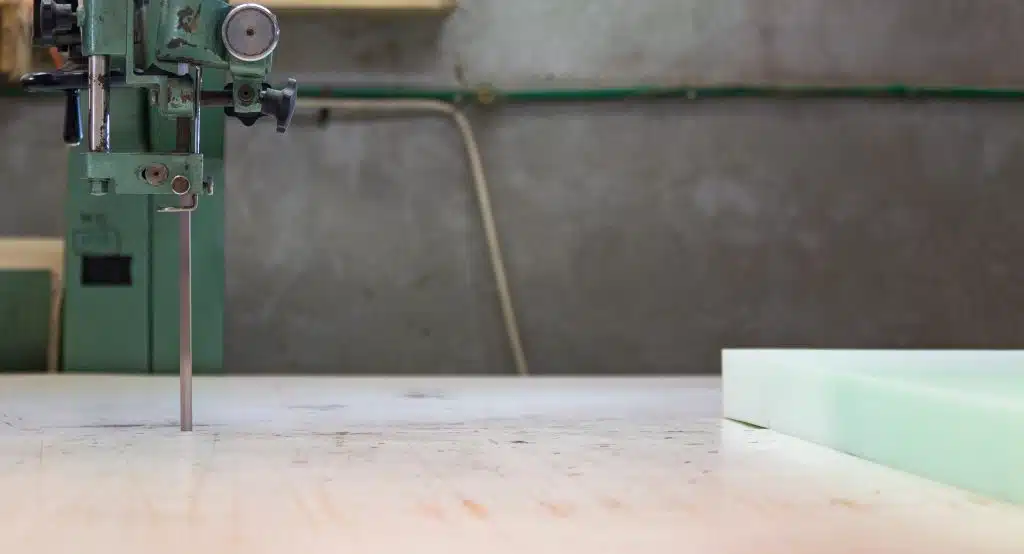
Even the highest-quality bandsaw blades can experience performance issues when operating conditions aren’t ideal. The good news? Many of these problems are easy to diagnose — and often just as easy to fix — once you know what to look for.
To be clear, Simmons Knife & Saw does not manufacture bandsaw machinery, and we highly recommend referring to your bandsaw’s manual or contacting your bandsaw’s OEM directly for instructions on maintenance and repair.
However, Simmons does have decades of experience helping customers troubleshoot issues with bandsaw blades. To help keep your cuts clean and your blades running longer, we’ve compiled a guide to the most common issues bandsaw operators encounter, along with their likely causes and recommended solutions. You can check them out below.
1. Scoring or Gouging on the Side of the Blade
If you notice unwanted marks on the blade’s side, the issue is often linked to debris or guide alignment.
Probable Causes & Solutions
- Material caught in ribbon or stripper guide → Clean the guide thoroughly.
- Blade guides are misaligned → Realign guides according to your machine manual.
- Damaged guides → Replace guides.
2. Hairline Cracks in the Gullets
Gullet cracks are often an early indicator of stress, tension issues, or mechanical misalignment. This usually only affects C-Tooth, Flexback, and V-Tooth Blades.
Probable Causes & Solutions
- Build-up on band wheels → Clean wheels; adjust wipers.
- Over-tensioning → Use proper blade tension.
- Improper tracking on crowned wheels → Track blade in the center of the crown.
- Guide arm set too far forward → Adjust guide arm to be parallel to the blade.
- Blade gauge too thick → Switch to a thinner gauge.
- Misaligned or worn band wheels → Realign, repair, or replace.
- Worn wheel bearings → Replace bearings.
3. Hairline Cracks on the Back Edge of the Blade
Back-edge cracking often involves tension, tracking, or guide positioning.
Probable Causes & Solutions
- Build-up on band wheels → Clean wheels; adjust wipers.
- Guide arm set too high → Match arm height to the material being cut.
- Improper tracking on crowned wheels → Track blade in the center of the crown.
- Over or under-tensioning → Use proper tension.
- Excessive feed pressure → Reduce pressure.
- Worn or damaged backup guides → Replace guides.
- Blade gauge too heavy → Use a thinner gauge.
- Misaligned or worn wheels → Realign or replace.
4. Twist in Blade
A twisted blade is usually a sign of using the wrong blade width or poor guide alignment.
Probable Causes & Solutions
- Blade too wide for cutting radius → Use proper width.
- Blade guides improperly set → Readjust guides.
5. Jagged or Irregular Break
When a blade breaks unevenly, it typically points to feeding or guide problems.
Probable Causes & Solutions
- Overfeeding → Reduce feed pressure.
- Blade too wide for radius → Use proper width.
- Guide arm too high → Lower the guide.
- Blade does not properly set in backup block → Realign backup block.
6. Premature Blade Breakage
Premature breakage is often related to tension, tracking, or guide issues. A straight break indicated fatigue.
Probable Causes & Solutions
- Blade tension too high → Reduce tension.
- Damaged or improperly adjusted guides → Inspect and correct alignment.
- Guidepost not aligned → Adjust guidepost.
- Build-up on wheels → Clean wheels or adjust wipers.
- Improper tracking → Track properly per machine manual.
- Blade gauge too thick → Use a thinner gauge.
7. Loss of Set (One or Both Sides)
Loss of set can quickly compromise cutting performance.
Probable Causes & Solutions
- Teeth riding too far back in guides → Adjust guides.
- Set riding on steel wheels → Adjust tracking so teeth ride off the wheel’s front edge.
8. Burnishing or Discoloration on the Blade Side or Edge
Discoloration indicates friction, heat, or improper tracking.
Probable Causes & Solutions
- Guide pads too tight → Readjust pads.
- Blade mistracking across wheels → Track properly.
- Blade too thick for guide → Use a thinner gauge.
9. Angular Cut (Left or Right)
Angled cuts tend to be the result of guide, tension, or blade selection issues.
Probable Causes & Solutions
- Loose or worn guides → Readjust or replace.
- Misaligned rails, fence, or guide arm → Realign.
- Damaged teeth → Inspect guides and tracking.
- Excessive feed force → Reduce feed pressure.
- Wrong type of blade → Use the proper blade for the material.
- Low band tension → Increase tension.
- Improper bevel grinding → Grind bevel evenly.
10. Angled or Wavy Cut
If your cut wanders or waves, consider tension, bevel, or blade condition.
Probable Causes & Solutions
- Ribbon guide angle incorrect → Adjust angle.
- Ground bevel incorrect → Regrind.
- Insufficient blade tension → Tension properly.
- Dull blade → Sharpen or replace.
- Too much or too little blade exposed → Limit to ¼” exposure.
- Wrong type of blade → Increase beam strength or use set-tooth blade.
11. Blade Slows Down or Jams in Guide
A blade that drags or jams is typically burdened by residue.
Probable Cause & Solution
- Build-up of gummy residue → Clean guide slot with solvent.
12. Shadow Marks
Shadow marks indicate irregularities with the weld, tracking, or tension.
Probable Causes & Solutions
- Misaligned weld → Contact manufacturer.
- Dogleg blade movement → Check blade straightness.
- Low tension → Apply proper tension.
- Improper tracking → Re-track blade.
- Cutting edge not properly ground → Regrind.
- Dip in weld zone → Contact manufacturer.
13. Mushrooming of Back Edge
Mushrooming is typically a sign of excessive pressure, improper guides, or misalignment.
Probable Causes & Solutions
- Excessive feed force → Reduce feed.
- Wrong blade type → Select correct blade.
- Frozen or worn backup roller guide → Repair or replace.
- Misaligned/worn backup guide → Realign or replace.
- Misaligned wheels → Realign wheels.
- Dull blade → Sharpen or replace; reduce feed force.
- Insufficient tension → Use proper tension.
Keep Your Blades Running Their Best
Hopefully, this guide can act as a useful starting point for troubleshooting common issues related to your bandsaw blades. However, we’d like to emphasize once again that you should always refer to your bandsaw’s manual or contact your OEM directly for support when performing bandsaw maintenance or repairs.
With that being said, if you’re having difficulty troubleshooting issues with your bandsaw blades or need guidance on selecting the right blade for your specific application, the Simmons team is always here to help.
Contact us today to learn more about how Simmons can optimize your cutting operations!

 English
  Spanish