
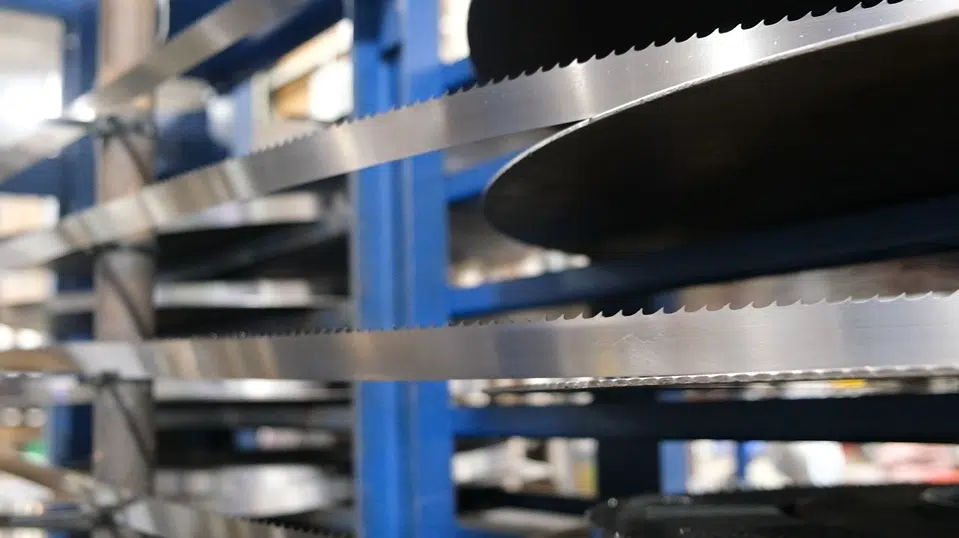
If your operation involves cutting bone-in meats like beef, pork, fish, or poultry, having the right butcher blade is essential.
SimCut Butcher blades are engineered from specialized steel and feature a superior tooth configuration designed to deliver fast, clean cuts with minimal waste. The result? Longer blade life and reduced overall cutting costs, even in demanding, high-volume environments.
Choosing the Right Teeth Per Inch: 3 vs. 4 TPI
One of the most important features to consider when selecting a butcher band saw blade is the number of teeth per inch (TPI). Butcher blades commonly feature 3 TPI or 4 TPI. Neither TPI option is universally “better.” The right choice depends entirely on your application.
When to Choose 3 TPI
Best for:
- Large primal cuts of beef or pork
- Heavy bone content (split beef quarters, pork shoulders, frozen blocks)
- High-throughput production environments
- Frozen or partially frozen product
Why it works:
- Larger gullets clear bone dust and fat more efficiently
- Reduced heat buildup during aggressive or continuous cutting
- Greater durability when running higher feed rates
Tradeoffs:
- Rougher surface finish
- More visible tooth marks on softer meat
When to Choose 4 TPI
Best for:
- Smaller cuts and boxed meat
- Trim work and portion control
- Fresh or chilled product
- Applications where appearance matters
Why it works:
- More teeth in contact with the product produce a smoother cut
- Improved control on thinner or more delicate sections
- Reduced tearing of soft tissue
Tradeoffs:
- Slower feed rates
- Less forgiving in heavy bone or frozen applications
- Can load up faster if pushed too hard
Frozen vs. Fresh: A Key Consideration
One key consideration to keep in mind is that product temperature plays a major role in blade performance:
A 3 TPI butcher blade will almost always be the best choice for cutting frozen meat, while a 4 TPI butcher blade will work well with fresh or chilled meats when the bone content is light.
Many processors try using 4 TPI on frozen product but switch back to 3 TPI due to slower cutting speeds or increased tooth wear.
Simple Rule of Thumb
If you take away anything from this blog, let it be the following:
- If the meat you’re cutting is big, frozen, or bone-heavy → 3 TPI
- If the meat you’re cutting is smaller, fresh, or appearance-critical → 4 TPI
While there are exceptions to any rule, using the above as a general guideline should serve your cutting operations well.
Built for Versatility and Compatibility
SimCut Butcher blades are manufactured with precise hardening and tightly controlled set tolerances, ensuring the strength and durability needed to handle tough bone-in applications day after day. Additionally, SimCut butcher blades are available in both carbon steel and stainless steel for both bandsaws and reciprocating saws to meet your specific processing needs.
SimCut butcher blades are compatible with a wide range of OEM equipment, including:
- Biro
- Butcher Boy
- Grasselli
- Hobart
- Jarvis
Packaging That Supports Your Brand
Simmons also offers flexible packaging options to align with your brand. SimCut Butcher blades can be wrapped in red, white, blue, or orange paper, each available with private labeling that includes your company’s branding and contact information.
Fast Turnarounds You Can Count On
With most standard sizes in stock, Simmons can ship quickly—often within 1–2 days, with same-day shipping available for common blade sizes.
Ready to optimize your cutting performance? Contact Simmons today to request a quote.


 English
  Spanish