Simmons Knife & SawSimmons Knife & Saw

  • MAISON
  • INDUSTRIES
    • LAMES DE COUPE DE MOUSSE
    • LAMES À COUPER LA VIANDE
    • LAMES DE COUPE POUR PRODUITS FRAIS
    • LAMES À TRANCHER LE PAIN
    • COUTEAUX D'EMBALLAGE
    • LAMES POUR FENDRE LE CUIR
    • LAMES DE COUPE DES MÉTAUX
    • LAMES DE COUPE DU BOIS
    • PLUS DE LAMES DE COUPE
  • À PROPOS DE NOUS
    • NOTRE ÉQUIPE
    • NOTRE HISTOIRE
    • LA VALEUR DE SIMMONS
    • SIMMONS DANS LE MONDE ENTIER
    • CARRIÈRES
    • CONDITIONS DE VENTE ET D'ACHAT
    • POLITIQUE DE CONFIDENTIALITÉ
  • PRODUITS
    • LAMES APEX
    • LAMES B-3
    • LAMES M42 BIMÉTAL
    • LAMES À TRANCHER LE PAIN
    • LAMES DE BOUCHER
    • LAMES DE CARCASSE DURASPLIT DE BOUCHER
    • LAMES DE DENT EN C
    • LAMES À GRAIN DE CARBURE
    • LAMES À POINTES EN CARBURE
    • LAMES CNC
    • LAMES À LIGOTAGE DANS LA GORGE
    • LAMES FLEXBACK
    • LAMES DE BANDE DE MEUBLES
    • LAMES DE DÉCOUPER LES ALIMENTS
    • LAMES À DOS RIGIDE
    • LAMES EN NID D'ABEILLE
    • LAMES DE COUTEAUX – ÉTROITES
    • LAMES DE COUTEAUX – LARGES
    • LAMES À DOS DE RASOIR
    • PALES DE COCHONS
    • COUTEAUX DE TRANSFORMATION DES PRODUITS DE LA MER
    • SIMCOR® LAMES
    • LAMES À ENCOCHE SPÉCIALE
    • LAMES DE TRAITEMENT DES TISSUS
    • LAMES À DENTS EN V
    • LAMES ONDULÉES
    • LAMES DE FIL
    • MEULES ET ACCESSOIRES
    • COUTEAUX D'EMBALLAGE – MACHINES À SCELLER LES GOBELETS ET LES PLATEAUX
    • COUTEAUX D'EMBALLAGE – MACHINES DE FORME, DE REMPLISSAGE ET DE SCELLAGE HORIZONTALES
    • COUTEAUX D'EMBALLAGE – MACHINES D'EMBALLAGE SOUS VIDE
    • LAPIN D'EMBALLAGE – MACHINES VERTICALES DE FORME, DE REMPLISSAGE ET DE SCELLAGE
    • COUTEAUX D'EMBALLAGE – SCELLEUSES DE CAISSE
  • DEMANDER UN DEVIS
  • ACTUALITÉS ET OPINIONS
  • CONTACTEZ-NOUS
    • CONTACTEZ-NOUS
    • BULLETIN

The Importance of Blade Tension

par SIMMONS / 22 avril 2022 / Published in pointes de lame

While it may not seem important at first, the extent to which you tension your bandknife or bandsaw blades can literally make or break your finished product. That’s why it’s imperative to properly apply blade tension before you run it on a bandsaw and look out for signs of under or over tensioning while it’s in use.  

If you’ve ordered a new bandsaw, the manufacturer will typically set the blade tension for you. However, if you’re tensioning the blade yourself, then you should know there are two ways to go about it: manually or automatically. 

MANUAL BLADE TENSIONING

Manual tension can be applied by springs or spring washers. However, the washers and/or springs will eventually collapse over time. This will cause the blade to overtighten and usually results in premature blade breakage. If this occurs, Simmons strongly recommends contacting the machine manufacturer for replacement parts and correct settings for the tension. 

AUTOMATIC BLADE TENSIONING

Automatic tensioning is applied through a pneumatic cylinder (air over oil). This tensioning method tightens the blade to a pre-determined level, which can usually be read off a dial indicator. Normally, automatic tensioning is very consistent. However, low air pressure or water in the air system can affect it.

No matter the method, after you tension your blades, you should look out for the following signs during normal cutting operations.

SIGNS OF AN OVER TENSIONED BLADE

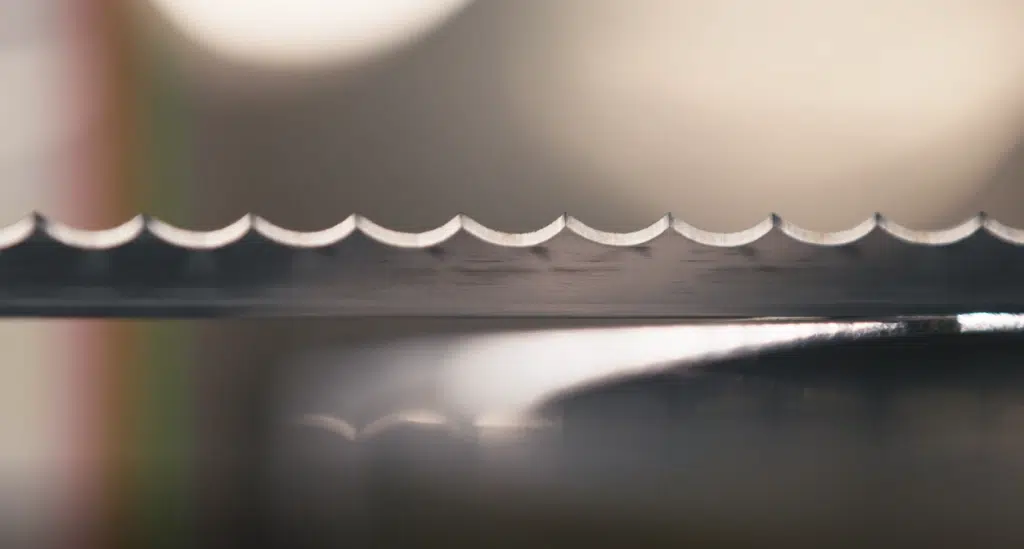
  • Hairline cracks develop in the gullet of toothed blades.
  • Hairline cracks develop on the back edge of the blade.
  • Premature blade breakage, typically a straight break.

SIGNS OF AN UNDER TENSIONED BLADE

  • The blade is not cutting straight.
  • The blade is leaving marks or shadows on the material being cut.

To recap, consistently and properly tensioning your blades will reduce the risk of premature blade breakage and ensure your blades run smoothly until the end of their natural life. Simmons’ blades (depending on the width and thickness) are made to withstand a blade tension range of 16,000 – 21,000 PSI. Feel free to use that as a guideline. However, to confirm you’re getting consistent tension readings, you should measure tension during each installation of a new blade on your bandsaw machinery.

Want to get extremely accurate blade tension readings in a cinch? Contact Simmons today to try one of our tension meters!  
Contactez-nous
Tagged under: Blade Tension, pointes de lame

What you can read next

5 things to look for in a bandsaw blade manufacturer.
5 Things to Look for in a Bandsaw Blade Manufacturer
Assorted packaging knives
A Guide to Simmons’ Packaging Knives
The Dos and Don’ts of Grinding Wheels

Catégories

  • À propos de Simmons
  • pointes de lame
  • Nouvelles
  • Simmons fait un don
  • Non classé

Articles récents

  • Simmons Knife & Saw célèbre 80 ans de fabrication de solutions de coupe industrielles

    Glendale Heights, Illinois — [1er avril 2026] Simmons….
  • Lames de scie à ruban SimCut pour boucher : Choisir la bonne lame pour la découpe de viande avec os

    Si votre opération implique la découpe de viande avec os...
  • Lames pour la transformation des aliments : découpe et tranchage de la viande | Guide complet de Simmons

    L'industrie agroalimentaire est l'une des plus importantes...
  • Que peut-on attendre de Simmons en 2026 : maintenir la dynamique et célébrer les étapes importantes ?

    Les deux pieds bien ancrés en 2026, je suis...
  • Bilan de l'année 2025 : une année record pour Simmons

    À l'approche de la fin de l'année 2025, je suis fier de dire ceci...

Simmons' 80th Anniversary Logo

  • INDUSTRIES
  • À PROPOS DE NOUS
  • PRODUITS
  • DEMANDER UN DEVIS
  • ACTUALITÉS ET OPINIONS
  • CONTACTEZ-NOUS

400 Regency Drive, Glendale Heights, IL 60139 |  Courriel : ventes@simcut.com |  Numéro de téléphone : +1 630 912 2880

400 Regency Drive, Glendale Heights, IL 60139
Courriel : ventes@simcut.com
Numéro de téléphone : +1 630 912 2880

©2022 SIMMONS KNIFE & SAW. Tous droits réservés.
Aucune image ne peut être utilisée, reproduite ou transmise sous quelque forme ou par quelque moyen que ce soit sans l'autorisation écrite préalable de Simmons Knife & Saw.

HAUT
fr_FRFrench
en_USEnglish es_MXSpanish it_ITItalian de_DEGerman pt_BRPortuguese (Brazil) pt_PTPortuguese (Portugal) fr_FRFrench